Responsible wildlife watching
Swimming with turtles in Martinique without disturbing them
Turtles visit seagrass meadows at Anse Dufour and other bays, but they are protected wild animals. Plan a safe snorkel, keep your distance and treat every sighting as a possibility, never a promised service.
The essential rule: observe, never provoke an encounter
A turtle does not come for swimmers. It feeds, breathes, rests or crosses the bay. Your behaviour should allow it to continue exactly what it was doing before you arrived. If it suddenly changes direction, speeds up or tries to move away, increase the distance.
The Martinique Marine Nature Park gives four simple rules for watching turtles at sea:
- keep about five metres between you and the turtle;
- never touch it;
- do not chase it;
- remain at the surface while watching.
These rules matter more than a photograph. Do not dive towards the animal, block its route to the surface or form a circle of swimmers around it.
Where might you see a turtle?
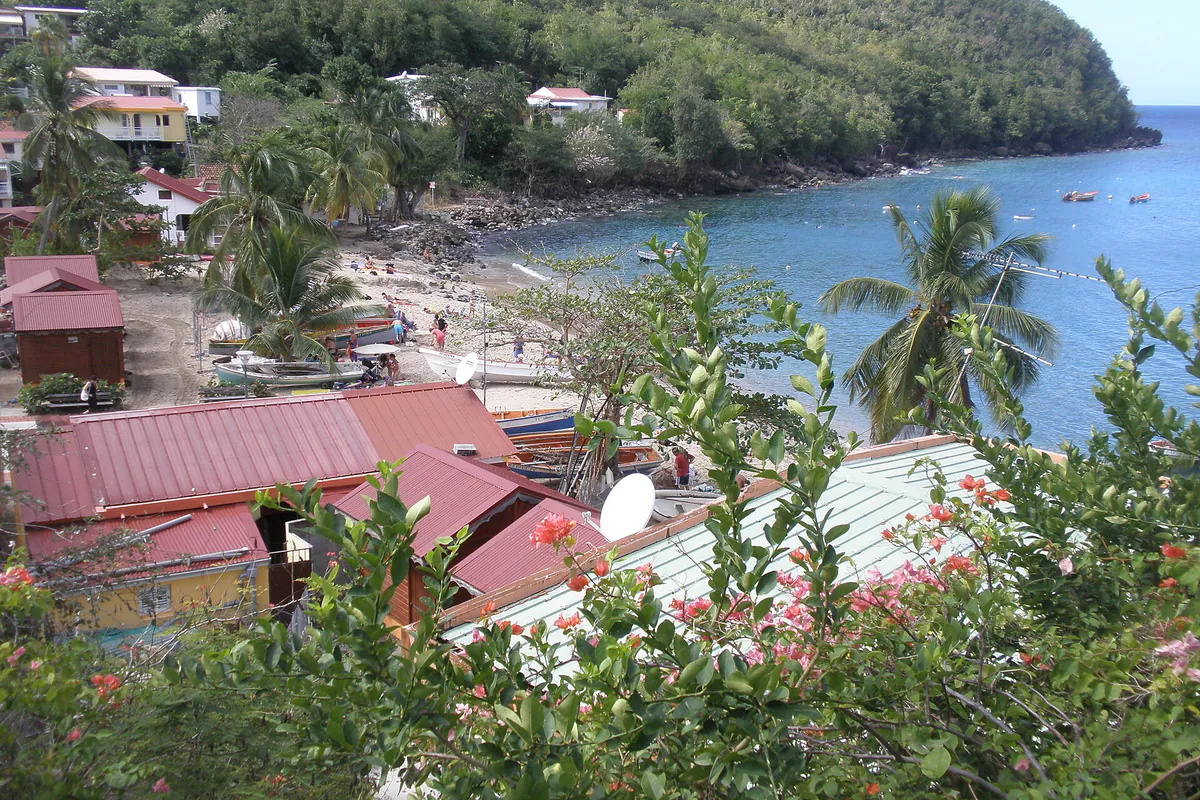
Anse Dufour is most often mentioned because turtles may feed in its seagrass. Grande Anse d’Arlet and other parts of the Caribbean coast also contain suitable habitat. That does not turn any beach into an aquarium: the animal may be absent, remain far offshore or avoid a crowded area.
First choose a site that matches your swimming ability and the day’s conditions. A bay known for turtles is a poor choice when the return to shore, boat traffic or crowding makes you uncomfortable.
Anse Dufour
The small beach makes access, parking and space sensitive issues. Arrive without assuming there will be room, respect residents and local professionals, and keep another cove as a fallback. In the water, stay clear of boat channels and locate vessels before looking down.
Grande Anse d’Arlet
The larger bay can spread different activities over more space, but it also has boats and working areas. Identify the markers and your exit. Do not follow a turtle until you lose track of your distance from shore.
A guided boat trip
A guided outing can help a less experienced swimmer, provided the operator promises neither contact, feeding nor a guaranteed encounter. Ask how many people enter the water, what flotation equipment is supplied, how boat channels are managed and what happens when the sea is unsuitable.
Before entering the water
Check the Météo-France coastal marine forecast and Martinique warning level. At the beach, observe waves, wind, flags, signs and boat movement. Clear water is not automatically free of current.
An official Martinique bathing-water record provides access to health monitoring and navigation between sites in département 972. After heavy rain or when a local prohibition is displayed, postpone swimming even if other people enter the water.
Ask yourself four questions:
- Can I return to shore unaided if I see no turtle?
- Is the wind pushing me offshore or away from my exit?
- Am I clearly visible from a boat?
- Will I still have enough energy for the return after watching?
An uncertain answer is a reason to use a guide, stay nearer the shore or abandon the swim.
Useful equipment without overloading yourself
A well-fitting mask and a snorkel you have already tested matter more than a camera. Short fins can make the return easier, but also increase the chance of striking the bottom: keep your legs horizontal and high enough to clear it.
A less confident swimmer should use a suitable buoyancy aid and seek advice from a professional. An inflatable toy is not safety equipment. Do not go alone, and agree on a simple signal to end the outing.
Covering sun protection reduces the amount of product applied just before entering the water. Bring drinking water and rest in the shade; floating still at the surface exposes the back and legs strongly to the sun.
When a turtle appears
Stop kicking rapidly, raise your head to locate other swimmers and leave the animal an open route. Stay to its side rather than in front. If it rises to breathe, never position yourself between the turtle and the surface.
Do not chase a face-on photograph. A camera held at arm’s length often reduces the distance without the swimmer noticing. Use no pole, flash or food. If several people arrive, move away: adding another swimmer increases pressure on the animal.
A brief encounter at a good distance is better than a long pursuit. Leave the area before fatigue develops and return along the route you identified earlier.
Protect seagrass and coral
Seagrass is habitat and a feeding ground, not an underwater lawn. Avoid standing on it, tearing it with fins or dropping an anchor into it. If you need to stop, remain buoyant or move to a clearly bare patch of sand without trampling the bottom.
Do not touch coral or turn stones over. Take no animal, living shell or fragment. Carry rubbish away, and tell a guide about fishing line or a hazardous object rather than attempting a risky intervention yourself.
The official Les Anses-d’Arlet marking plan brings together navigation, anchoring and water-activity rules for the area. Signs and buoys seen on site remain your immediate reference.
A turtle on the beach: different rules apply
A nesting turtle is particularly vulnerable. The marine park asks observers to stay ten metres away, extinguish artificial lights, use no flash and touch neither the animal nor its eggs. Do not stand in front of it, and leave the route to the sea open.
Do not improvise by carrying hatchlings to the water. Let them make the journey themselves, switch lights off, contain the crowd and remove only an immediate obstacle without handling the animals. For an injured, stranded or distressed animal, use current contacts published by local authorities rather than an old copied telephone number.
All marine turtle species are protected. A night sighting should not become an independent search on a nesting beach; choose activities supervised by the competent conservation networks.
Children and non-swimmers
A child comfortable with a mask in a pool may be surprised by waves, salt and depth. Begin where they can stand, without a wildlife objective. One adult must be dedicated solely to immediate supervision, not looking into the distance themselves.
For a non-swimmer, watching from a boat or taking a coastal walk may be the right choice. Never let a commercial promise of turtles push somebody into water beyond their ability.
How to recognise a responsible excursion
The guide begins with safety and distance, limits the number of people around an animal and accepts that an outing may produce no sighting. They do not feed, attract or touch turtles and do not encourage participants to dive towards them. They understand the local markers and offer a fallback when the sea deteriorates.
Be cautious of wording such as “guaranteed encounter”, “swim up close” or “photo with a turtle”. The quality of an excursion is measured by respect for wildlife and the group’s ability to return calmly.
Plan the rest of the day
A morning snorkel combines well with a visit to Les Anses-d’Arlet town or a beach selected after checking conditions. Avoid racing from cove to cove merely to increase the odds: that adds parking pressure, crowds and fatigue without guaranteeing an encounter.
Use the Martinique beach guide to find an alternative that remains worthwhile without wildlife. If the south-west is a priority, compare bases in where to stay in Martinique to reduce driving and arrive before the busiest periods.
Useful points on the ground
Addresses and maps
Anse Dufour
Les Anses-d'ArletFranceSeagrass and shore snorkelling from a small, popular beach; no sighting is assured.
Grande Anse d'Arlet
Les Anses-d'ArletFranceA larger bay with water activity; identify boat channels and your exit point before setting off.