Practical transport
Getting to and around Martinique: airport, car, buses and ferries
The right transport depends on where you stay and which days matter most. Secure your arrival transfer first, then combine a car and public transport only where each genuinely helps.
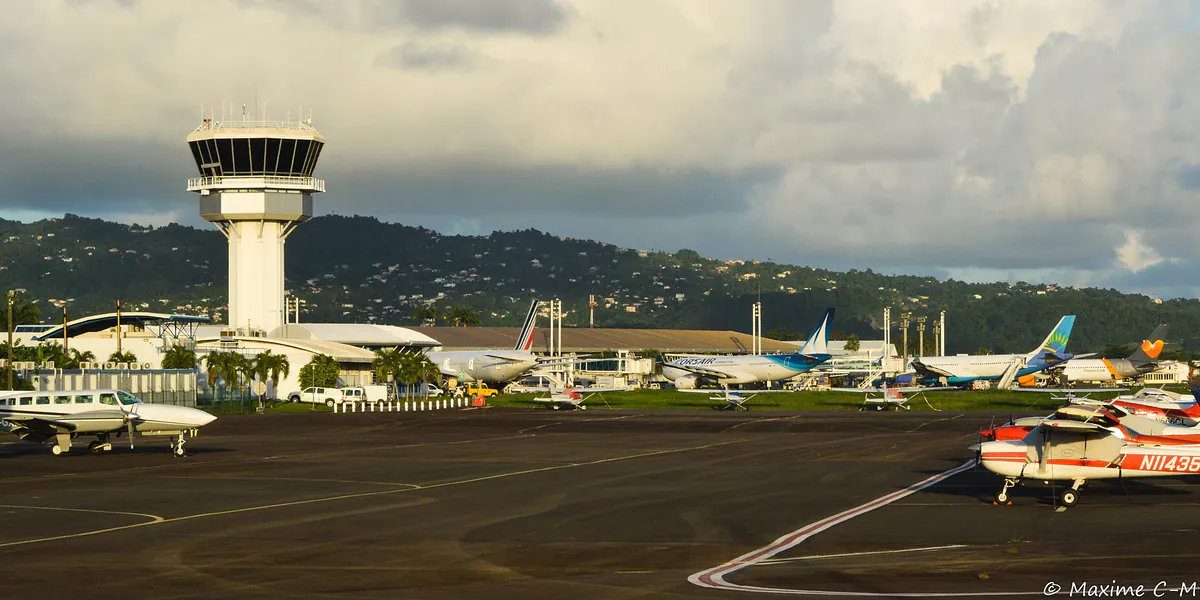
Most travellers arrive at Martinique Aimé Césaire International Airport in Le Lamentin. Its airport code is FDF, but the terminal is not in central Fort-de-France. That distinction matters when ordering a taxi, meeting a hire-car company or calculating your first journey.
Entry requirements: use the official assistant
Required documents depend on your nationality, length and purpose of stay and the countries through which you travel. Martinique is a French overseas territory; do not assume that a document or visa valid for another territory automatically covers this trip.
Use the official France-Visas assistant, then check transit requirements for every connection. The airline checks documents before boarding but does not replace the border authority.
Languages: French and Martinican Creole
French is used for formalities, road signs and official information. Martinican Creole is also part of the island’s daily life and heritage. A French-speaking visitor can organise a trip in French. A few Creole greetings may open a conversation, but it is better to ask how a word is pronounced than to imitate an accent.
In a practical exchange, begin with a greeting, explain your request clearly and let the other person choose the language. Ask for written confirmation when a detail in a document, safety instruction or booking remains ambiguous.
Before landing: secure five details
- the exact address of your first accommodation;
- the name and meeting point of the hire company, taxi or transfer;
- the procedure if the flight is delayed;
- a way to contact the accommodation without mobile data;
- an offline map between the airport and your destination.
The Martinique Aimé Césaire Airport website provides flight information and access guidance. Use the airport’s official taxi page rather than following someone who approaches you without clear identification.
Should you hire a car?
| Your itinerary | Car | Alternative to investigate |
|---|---|---|
| Several beaches, trails and towns | Often practical | Pick-up excursions for a few targeted days |
| Fort-de-France and the bay | Parking may make it a burden | TCSP, bus, walking and ferry network |
| One beach accommodation | Useful only on certain days | Taxi, ferry or short-term hire depending on the area |
| Group carrying equipment or with reduced mobility | Can simplify door-to-door travel | Pre-booked adapted vehicle and confirmed access at every site |
A car provides flexibility, not empty roads. Central routes can be busy and northern roads winding. Group visits by area and leave a margin.
Check the contract and vehicle
Before leaving the car park:
- read the excess, exclusions, permitted drivers and breakdown assistance terms;
- photograph all four sides, wheels, windows, interior and fuel gauge;
- have every existing mark recorded;
- ask which fuel is required and how it must be returned;
- test lights, wipers, air conditioning and locks;
- save the number to call if the car breaks down.
Do not leave passports, suitcases or devices visible in the vehicle. A quick beach stop is not a luggage-storage service.
Buses, TCSP and local networks
Martinique Mobilités brings together route planning, timetables and traffic information. Different networks serve different areas; a central route does not automatically continue to a remote beach.
Use the official journey planner with:
- the exact stop, not just the town;
- the date and time;
- the return journey;
- walking time to the final destination;
- published alerts and diversions.
The TCSP operates along a defined central corridor. It can help between Le Lamentin and Fort-de-France, but you still need to check the first and last part of the journey.
Ferries and bay shuttles
The ferry network connects Fort-de-France with points around the bay, including the Les Trois-Îlets side. It is both transport and a pleasant view of the bay, but only when the timetable works for your return.
Confirm the exact landing, route, last useful departure, rules for luggage, pushchairs or wheelchairs, and a fallback if the service is disrupted. Consult the official ferry network page.
Taxis and private transfers
For an important journey, ask for the pick-up point, how the fare is calculated or the quoted price, possible surcharges, payment method and actual luggage capacity. Obtain explicit advance confirmation for a child seat or accessible vehicle.
Keep the provider’s name and number. A message saying only “I will be there” with no location or identity is not enough for a late arrival.
Driving and local conditions
Adjust your speed for rain, bends, towns and visibility. A road that looks dry can become slippery during a shower. Do not follow an app down a route that is plainly unsuitable for your vehicle.
For a hike or sea excursion, return transport is part of the activity. Save the finishing point, particularly when the route does not return to where it started.
Sources to use on the day of travel
- Martinique Aimé Césaire Airport;
- Martinique Mobilités and its journey planner;
- Martinique Transport, the organising authority;
- France-Visas, for requirements matching your circumstances;
- Météo-France warnings, when weather may affect road or sea travel.
Run the route search again shortly before departure: timetables and disruptions are operational data, not constants in a travel guide.
Useful points on the ground
Addresses and maps
Martinique Aimé Césaire International Airport
97232 Le LamentinMartiniqueSave your terminal and the exact transport pick-up point before the flight.
Pointe Simon ferry terminal
97200 Fort-de-FranceMartiniqueCheck the landing shown for your ferry route; not every boat uses the same departure point.